Find out what the bug is and whether it's a problem

Point your camera at an insect, spider or household pest. Verhive tells you how sure the match is, whether it can hurt you, your pets or your home, and what to do next, starting with the gentlest option.

Verhive app screen: Find out what the bug is and whether it's a problem

Identify it, check the risk, deal with it

Then keep a log to see whether the problem is going away.

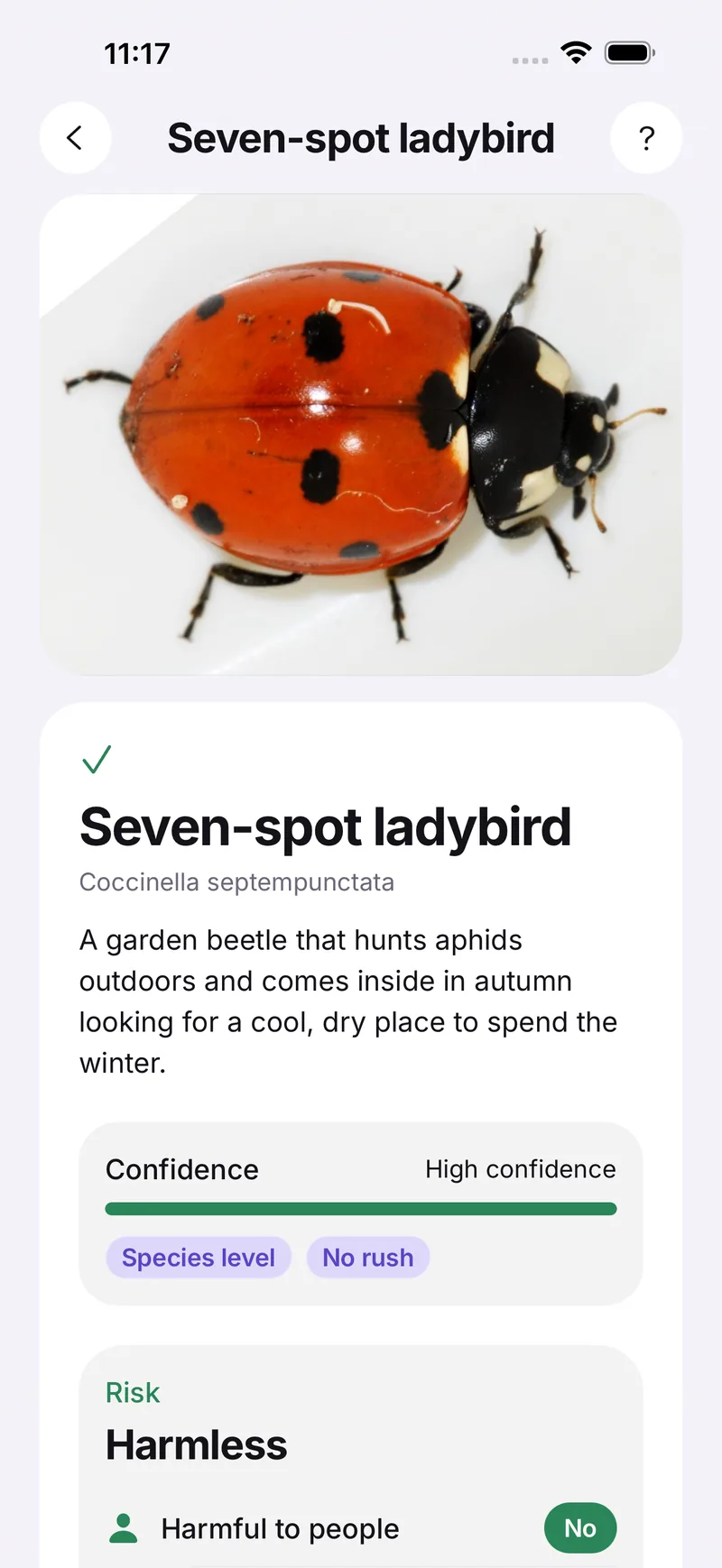
Verhive gives you the common name and the scientific name, the rank it reached and a confidence level that is never hidden behind a tap. You also see what the AI noticed in your photo and what else it could be.
Verhive app screen: An identification that tells you how sure it is

An identification that tells you how sure it is

  • Species, genus, family or order, stated plainly
  • Confidence shown on the result itself
  • Alternatives and the visible features behind the match
  • Spiders, ticks, mites and centipedes included, not just insects
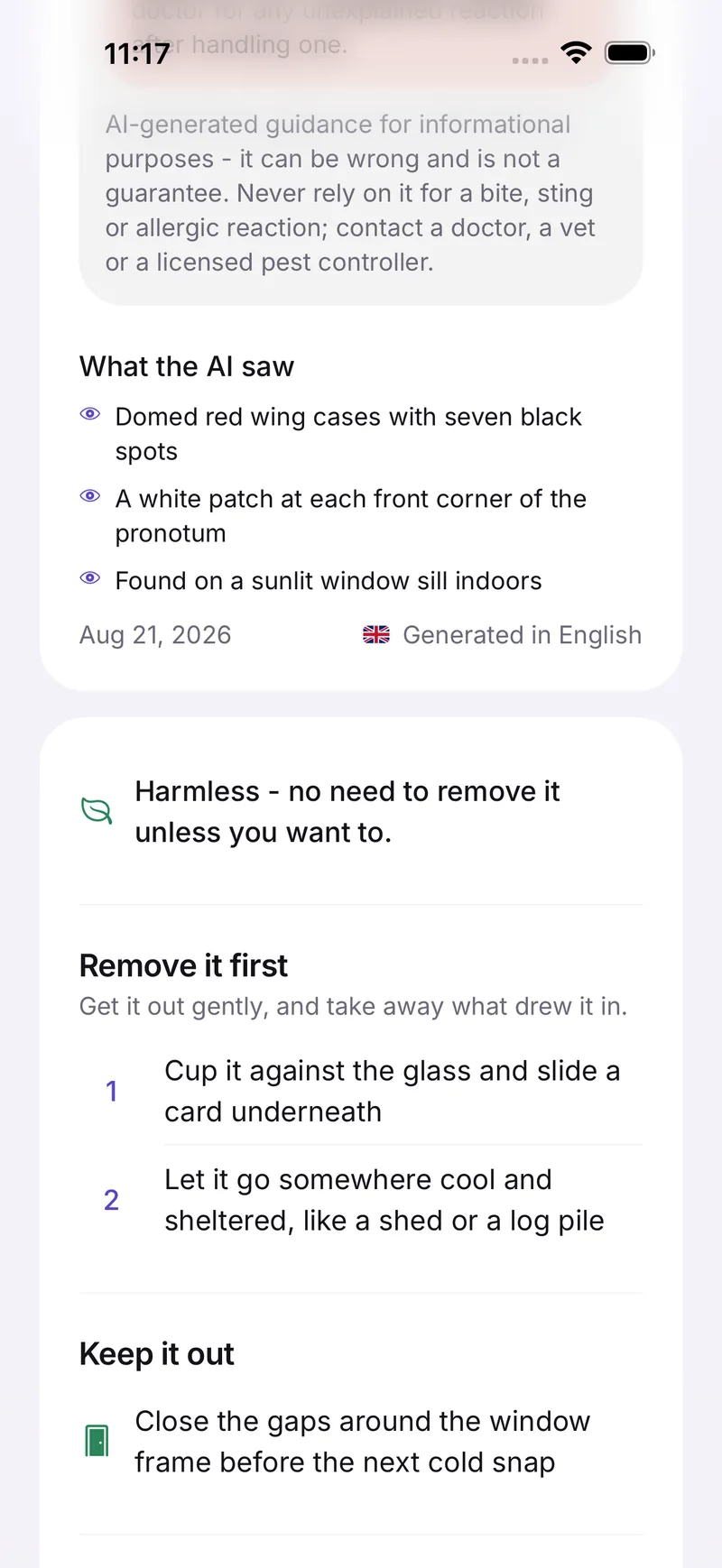
Every plan opens with removing the creature without harming it and taking away whatever attracted it. Prevention comes next. Control steps appear only when a creature is a genuine risk, and they come with safety notes and a reminder to follow the product label and local rules.

Verhive app screen: A plan that starts gently

A plan that starts gently

  • Remove first, keep out next, control only if needed
  • Clear signs for when to call a professional
  • Safety notes for anything you apply
  • A short note on the creature's role in nature

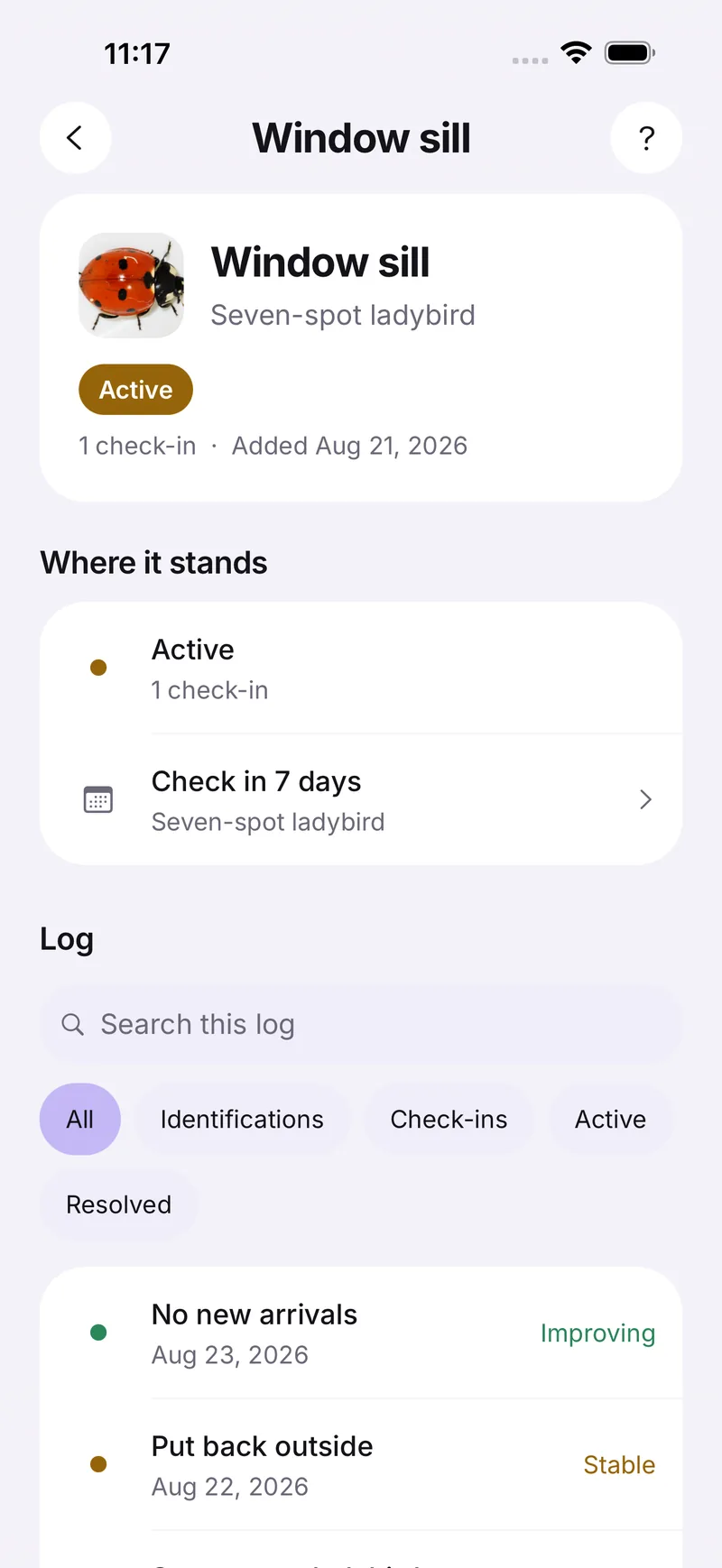
Save a sighting to a place in your home, record what happened, and pick up where you left off the next time it shows up.

Verhive app screen: A pest log, one place at a time

A pest log, one place at a time

  • One entry per place: the kitchen, the basement, the shed
  • Mark it as gone, still around or worse
  • Your history stays on your account
  • Delete a place, or your whole account, whenever you like

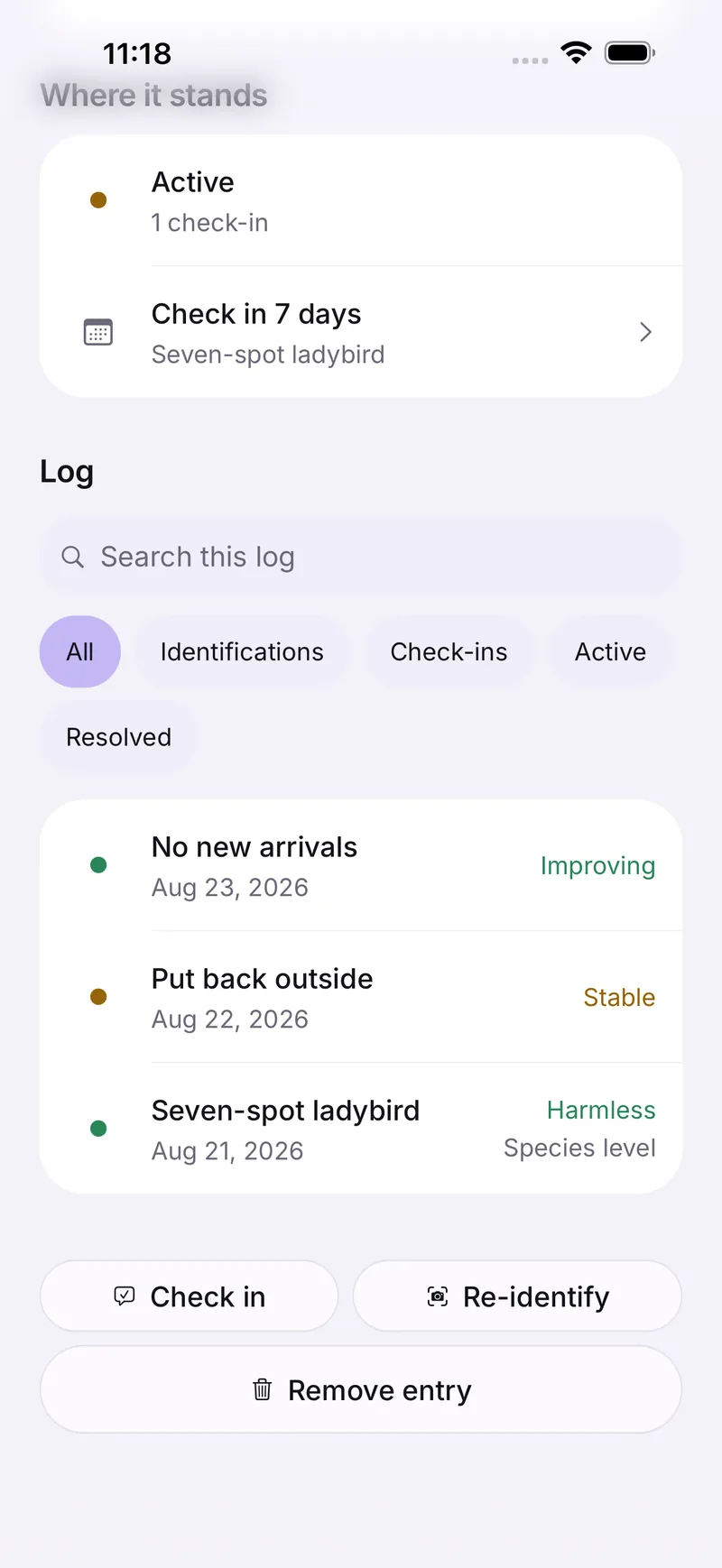
With Pro, send a new photo of the same spot. Verhive compares it with the first identification, the plan and your notes, says whether things are improving, stable or worsening, and suggests when to check again.

Verhive app screen: Photo check-ins that read the trend

Photo check-ins that read the trend

  • Compares against your original result and notes
  • Improving, stable, worsening or resolved
  • A suggested day to check again
  • Uses the same monthly Pro allowance as identifications

What to do when you find a bug None of these need an app.

Keep your distance and keep your hands off

Until you know what it is, do not pick it up with bare hands. Keep children and pets back, and watch where it goes instead of chasing it.

Photograph before you do anything else

Take a sharp photo from a comfortable distance, in good light, without flash if you can. Add a coin or ruler nearby for scale if it is safe to do so. A squashed bug is much harder to identify.

Use the cup and card method

For a single wanderer, place a glass or jar over it, slide stiff card underneath, and release it outdoors away from the door. It works for most spiders, beetles and bees without touching them.

Look for signs, not just the bug

Droppings, shed skins, discarded wings, webbing, fine dust or chewed fabric tell you more about whether something is living in your home than one sighting does.

What every result shows

Most bug apps stop at a name. Verhive also tells you how sure it is, whether it matters and what to do about it.

Verhive app screen: What every result shows

Pricing Start with a few identifications on your own bugs. Go Pro when you want to keep going and follow a problem over time.

Free

See the full result on your own bugs

  • 3 free identifications, ever
  • Full result: confidence, risk and a plan
  • Pest log and collection included
  • Sign in with Apple or Google
Download on the App Store
Recommended

Pro

For problems that keep coming back

  • 30 identifications or check-ins a month
  • Photo check-ins that show if it's improving
  • Same allowance on monthly, quarterly or yearly
  • Cancel anytime in your Apple account settings
Go Pro in the app

Prices vary by country and are shown in the App Store in your local currency before you subscribe. Subscriptions renew automatically until cancelled. The pest log and your collection stay available with or without Pro.

Frequently asked questions

  • Insects, spiders, ticks, mites, centipedes, millipedes, woodlice and other household pests, plus signs they leave behind. It is built for the bugs people find at home and in the garden.

  • We do not publish an accuracy figure, because any single number would mislead you. Instead, every result shows its own confidence and the rank it reached. Many insects cannot be told apart from one photo, so when the honest answer is a genus or a family, Verhive says that instead of guessing a species.

  • Some groups can only be separated by features too small to see in a photo, such as eye arrangement, wing veins or hairs. A family-level answer with the right risk information is more useful than a confident wrong species name. The result tells you what would help narrow it down.

  • No. Bite and sting marks are not specific to one species, and many skin problems are blamed on insects that were never there. Verhive identifies the creature in your photo, not a mark on your skin. If you are worried about a bite or sting, see a doctor.

  • No. Verhive never diagnoses anything and never suggests a medication. Every result includes the warning signs that mean you should get medical help, and in an emergency you should call your local emergency number.

  • Not by default. Every plan starts with non-lethal removal and taking away what attracted the creature. Control steps only appear when a creature is a genuine risk or you are dealing with an infestation, and Verhive never recommends killing a harmless species.

  • Only at a general level and only when a real risk calls for it, always with safety notes and a reminder that the product label and your local regulations come first. It never gives mixing ratios or homemade recipes, and it points to a professional for termites, bed bugs, stinging insect nests and venomous species.

  • Treat it as a fast, careful first opinion, not a final word. Identification from a photo can be wrong. If you suspect a dangerous species, keep your distance, keep children and pets away, and contact a professional or a doctor as the situation requires.

  • A place to follow a problem over time. Each entry is a named place in your home, like the kitchen or the garage, with its sightings and outcomes. Places are named by you, never pinned on a map.

  • A Pro feature. You send a new photo of a spot you are working on and Verhive compares it with the original identification, the plan and your notes, then reads whether things are improving, stable or worsening and suggests when to check again.

  • Yes. Photos are compressed on your device and stripped of location data before upload, sent to our AI provider to produce the result after you give permission, and kept in a private storage bucket that is never public. They are only reachable through short-lived links. Deleting your account deletes your photos.

  • Yes. Sign in with Apple or Google is required. Email and password sign-in is not offered.

  • 30 uses every calendar month that you can spend on identifications or check-ins in any combination. Monthly, quarterly and yearly billing all get the same 30 uses each calendar month. Prices vary by country and are shown in the App Store.

  • No advertising, no tracking and no third-party analytics.

  • Verhive runs on iPhone and iPad and is available in 16 languages: English, German, Spanish, French, Italian, Portuguese (Brazil), Japanese, Korean, Simplified Chinese, Turkish, Dutch, Polish, Russian, Indonesian, Vietnamese and Thai. Results appear in the language you choose.

Still have a question? Contact

How to tell if a bug is dangerous

Finding an unfamiliar bug in your bedroom, your kitchen or on your dog raises one question: is it a problem? Most of what you find indoors is harmless to people, and much of it is useful outdoors. But no single colour, shape or trick sorts dangerous from harmless. This guide covers how to think it through, what you can and cannot judge from a look or a photo, and what to do in the first few minutes.

Start from a safe distance

The first rule is simple: do not touch what you have not identified. Most bites and stings happen when a creature is pressed against skin, trapped in clothing or grabbed, not when it is left alone.

  • Step back and watch. Note where it is, how it moves, and whether there are more of them.
  • Keep children and pets away. Curious hands and noses are the most likely to get hurt.
  • Do not squash it if you can avoid it. A crushed specimen is much harder to identify, and some insects release irritating fluids when crushed.
  • Take a photo first. A clear photo lets you, an app or an expert look closely without anyone getting close.

If the creature is on a person and is not moving off, brush it away with a piece of paper or card rather than your fingers. If something is attached to the skin, such as a tick, follow your public health agency's guidance on removal and keep a note of the date.

Count the legs and look at the body plan

Before you can judge risk, you need to know roughly what group you are looking at. The body plan narrows it down faster than colour does.

What you see Likely group Examples
6 legs, body in three parts, often wings Insects Ants, beetles, wasps, bed bugs, cockroaches
8 legs, two body parts, no antennae Spiders House spiders, wolf spiders, widows, recluses
8 legs, body looks like one oval piece Ticks and mites Deer ticks, dog ticks, dust mites
Many legs, one pair per segment, fast Centipedes House centipede
Many legs, two pairs per segment, slow Millipedes Garden millipedes
14 legs, grey armoured body Woodlice (crustaceans) Pill bugs, sow bugs

This matters because different groups carry different kinds of risk. Insects may sting, bite, spread disease or damage your home. Spiders bite, and only a small number are medically significant. Ticks matter mainly because some carry disease. Millipedes and woodlice are harmless to people.

Understand how a bug can actually cause harm

Dangerous is too vague to be useful. It helps to ask how a particular creature could cause harm, because each route has its own warning signs and its own response.

  • Stings. Bees, wasps, hornets and some ants inject venom through a stinger. For most people a sting is painful but local. For people with a sting allergy it can be an emergency.
  • Venomous bites. Every spider has venom, but only a few have venom and fangs that matter to humans, such as widow spiders and recluse spiders in some regions, and funnel-web spiders in parts of Australia.
  • Disease. Some ticks, mosquitoes, fleas and kissing bugs can carry pathogens. The bite itself may be painless, which is why identification and timing matter.
  • Irritating hairs. Some caterpillars and carpet beetle larvae have hairs that can irritate skin, eyes or airways.
  • Allergens and contamination. Cockroaches and some pantry pests contaminate food and surfaces, and cockroach droppings are a known indoor allergen.

Once you know which route applies, you know what to watch for and who is most at risk.

Ask three separate questions: people, pets, home

A bug can be harmless to you and still be a problem for your dog or your house. Keeping the three questions separate makes the answer clearer.

People. Can it bite or sting, is it venomous, does it carry disease, does it contaminate food? Who in the household is most at risk: babies, older relatives, anyone with a known sting allergy?

Pets. Cats and dogs chase and eat insects. Some stinging insects are dangerous in the mouth or throat, some insects are toxic or irritating if eaten, and fleas and ticks are parasites in their own right. Your vet is the right person for anything involving your animal's health.

Home. Termites and some beetles damage wood. Carpet beetles and clothes moths damage wool, silk and other natural fibres. Pantry beetles and moths spoil stored food. These are not dangerous to touch, but they can be expensive if ignored.

Verhive answers these as six yes-or-no questions on every result: harmful to people, harmful to pets, bites or stings, venomous, spreads disease, damages your home. A missing answer would read as safe, so every row is filled in.

Why colour, size and hairiness mislead

People often judge danger by how frightening something looks. That rule of thumb fails in both directions.

  • Big and hairy is often harmless. Wolf spiders and huntsman spiders look alarming and are generally reluctant biters. Large moths, crane flies and many beetles cannot hurt you at all.
  • Small and plain can matter. Recluse spiders are modest brown spiders. Deer tick nymphs can be as small as a poppy seed. Termite workers are pale and soft and rarely seen in the open.
  • Bright colours are not a reliable warning. Some brightly coloured insects are harmless mimics of wasps, such as hoverflies. Some dangerous ones are dull.
  • Brown is not a species. A brown spider in a basement is far more likely to be one of many harmless species than a recluse, and recluses only live in certain regions.

Better clues are body plan, specific markings checked together, behaviour, where you found it and what region you are in. A single feature, such as a violin shape or a red mark, should never settle the question alone. Our guide to whether a spider is dangerous applies this to spiders.

What a photo can and cannot tell you

A good photo can tell you a great deal: the group, often the family, frequently the genus and sometimes the species. But many insects and spiders are separated by features that do not show at photo scale, such as eye arrangement, wing veins, tiny hairs or structures that need a microscope. Young stages like larvae and nymphs are often harder still.

That is why an honest identification states how far it could go. Family Theridiidae with high confidence is a real, useful answer. A confident species name that is wrong is not, especially if it turns a dangerous animal into a harmless one.

Verhive is built around this. Each result shows the rank it reached (species, genus, family or order) and how confident the match is at that rank, along with what else it could be. When a photo cannot settle something that matters for safety, the cautious answer is the right one.

To help any identification, whether by an app or a person:

  1. Shoot in good, even light, ideally daylight.
  2. Get the whole animal in frame and in focus, from above and from the side if you can do so safely.
  3. Include something for scale, like a coin, placed nearby without touching the bug.
  4. Photograph any signs too: droppings, shed skins, wings, webs or damage.

More tips are in our guide on how to photograph a bug for identification.

Signs matter as much as the bug

One beetle on a windowsill tells you very little. The same beetle plus a pile of shed larval skins in the wardrobe tells you a lot. When deciding whether something is a problem for your home, look for:

  • Droppings and stains. Dark specks along mattress seams, pepper-like droppings in cupboards, or smears near hiding spots.
  • Shed skins and egg cases. Evidence that something is breeding indoors rather than wandering in.
  • Discarded wings. Small piles of identical wings on sills after a swarm can point to termites or ants, which need different responses. See termites versus flying ants.
  • Damage. Irregular holes in wool, webbing in flour, fine dust under wooden furniture, or mud tubes on foundations.
  • Multiple life stages. Adults and young together usually mean an established population.

For bedrooms, bed bugs versus carpet beetles shows how much the signs reveal.

Repeated sightings in the same place are worth recording. A dated log of where and how many lets you or a professional see whether a problem is growing, steady or fading, instead of relying on memory. Keep in mind that a log counts what you saw, not everything that is there.

Where you live changes the answer

Region is one of the strongest clues you have, and it is often ignored. Many of the species people worry about most live only in certain parts of the world, so the same brown spider means something different in Missouri than in Manchester.

Group Where it is a concern What to know
Recluse spiders Central and southern United States and parts of South America, with related species around the Mediterranean and elsewhere Rarely seen outside their range; many brown spiders are mistaken for them
Widow spiders Found on every inhabited continent Glossy, round-bodied; look-alike false widows are far more common in parts of Europe
Funnel-web spiders Eastern Australia Treated as a medical emergency if a bite is suspected
Kissing bugs The Americas, from the southern United States to South America Can carry the parasite that causes Chagas disease
Ticks that carry disease Temperate regions worldwide, especially woodland and long grass Which diseases depend on the tick species and the region
Termites Warm and temperate regions worldwide Damage wood out of sight; need a professional inspection
Fire ants Native to South America, introduced to parts of the United States, Asia and Australia Painful stings, often many at once

If a frightening species is not known where you live, a look-alike is the likelier answer. That does not make it safe to handle, but it should lower your alarm and raise your curiosity. Travel, firewood, packing boxes and plant pots do move animals around, so an unexpected find is worth reporting to a local university extension service, museum or public health office.

Season matters too. Many insects move indoors in autumn to shelter for the winter, male house spiders wander in late summer looking for mates, and ticks and stinging insects are most active in the warmer months of your hemisphere.

The first five minutes: a humane-first routine

Most indoor encounters can be solved without harming anything.

  1. Contain without touching. For a single wandering spider, beetle or bee, place a glass or jar over it and slide stiff card underneath.
  2. Release it outdoors, a short distance from the house and away from doors and windows.
  3. Find out why it came in. Food left out, damp corners, an open window at night, a gap under a door or a light left on outside.
  4. Fix the reason. Seal gaps, store food in closed containers, reduce humidity and turn off unnecessary lights.
  5. Watch and record. If you see the same creature again in the same place, note it.

Skip this routine, keep your distance and get help instead if the creature might be a medically significant spider or scorpion, if it is a stinging insect near a nest, or if you suspect wood-destroying insects. Never try to remove or destroy a wasp, hornet or bee nest yourself, and never use a fogger or bug bomb. If you decide a product is needed for a genuine risk, use only what is labelled for that pest, exactly as the label directs, and follow your local rules.

When to see a doctor or call a professional

No app or article can assess a person. If you are worried about someone's health, get medical help. Call your local emergency number straight away if, after a bite or sting, someone has:

  • Trouble breathing, wheezing or a tight throat
  • Swelling of the face, lips, tongue or throat
  • Dizziness, fainting or confusion
  • Many stings at once, or a sting in the mouth or throat

Contact a doctor promptly if redness spreads or the area becomes hot and increasingly painful over hours, if a fever, rash or feeling generally unwell appears in the days or weeks after a tick bite (our tick identification guide covers what to note), or if severe pain, cramping or sweating follows a suspected spider bite. If you safely can, keep the creature or a photo of it to show the clinician.

For your pet, call your vet if there is facial swelling, drooling, vomiting, weakness or difficulty breathing after contact with an insect.

Call a licensed pest professional for suspected termites or other wood-destroying insects, bed bugs, wasp or hornet nests, and any infestation you cannot trace to a source. For a honeybee swarm, a local beekeeper or swarm collection service is often the best call, since bees are valuable pollinators and may be protected where you live.

Verhive is an information tool, not medical, veterinary or professional pest-control advice, and it says so on every result.

Bug and pest guides

Guides to working out what you found, whether it is a problem and what to do next.

Know what it is before you deal with it

Photograph it and see how sure the match is, whether it can hurt you, your pets or your home, and the gentlest way to deal with it.

Download on the App Store